



By Maggie Welch, Staff Limnologist
The 2025 sampling season began with several rainy weekends but ended in drought. The wettest months of May and June were the least clear and had higher chlorophyll and phosphorus values on most of our lakes. August and September were dry, and we observed better clarity with lower chlorophyll and phosphorus values. In general, wetter periods drive more runoff into waterbodies, lowering clarity and providing nutrients for algal growth. Dryer months tend to be clearer because there is both less particulate matter in the water and less algae.
This year, LEA’s water monitoring staff welcomed four interns to our team, twice as many as we have had in recent years. Leading the crew was Catherine Wheaton, a biology major from Reed College, who joined us for her second year as a water testing intern. Catherine was joined by Billy O’Connor, a comprehensive science major from Villanova University, Henry Baker, a recent graduate of St. Lawrence University’s Biology program, and Elly Burnham, a biology student from Loyola University. In addition to collecting hundreds of samples and taking thousands of water quality readings on our local lakes, Catherine, Billy, Henry, and Elly designed and implemented small research projects of their own, which are summarized below.
Henry: Where do the Gloeotrichia grow?
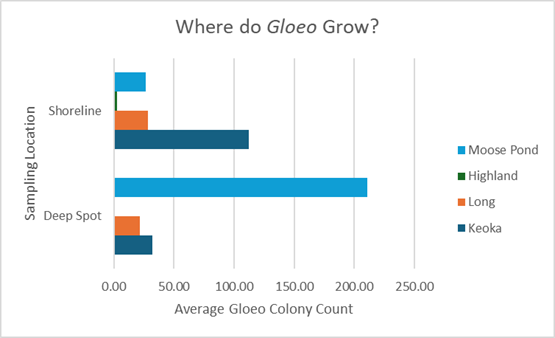
Henry quantified Gloeotrichia concentrations in water samples from both the deepest part of the lake and near-shore locations on Moose Pond, Highland Lake, Long Lake, and Keoka Lake (Gloeotrichia is a type of cyanobacteria found in low-nutrient lakes. See Ben’s article on page xx for more details).
Henry found that Highland Lake had the least amount of Gloeotrichia in both locations sampled. Moose Pond had more Gloeotrichia in the middle of the lake near the deepest location than at the shore. Keoka Lake had more Gloeotrichia near the shore than it did at the deep spot, and Long Lake had similar amounts of Gloeotrichia at both sampling sites. While more data would be needed to have conclusive results, his sampling did not indicate that Gloeotrichia is more prevalent near the shore, which is often presumed.
Catherine and Billy: Microplastics
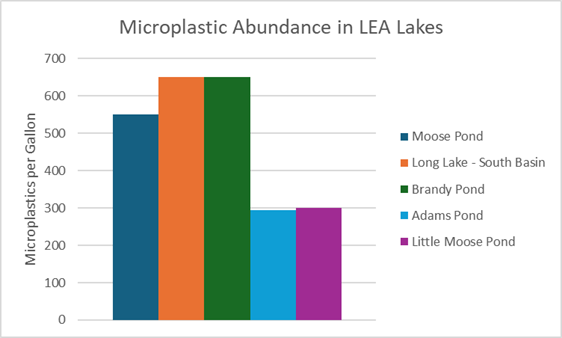
Catherine and Billy quantified microplastic densities from water samples collected near the middle of the lake on Moose Pond, Long Lake’s south basin, Brandy Pond, Adams Pond, and Little Moose Pond. In all water samples analyzed, they found microplastics. Brandy Pond and Long Lake had the highest densities, followed by Moose Pond, and Little Moose Pond and Adams Pond contained the least microplastics. In general, the level of microplastics in the water increased as the amount of development on the lake increased.
Elly: Water color in LEA lakes
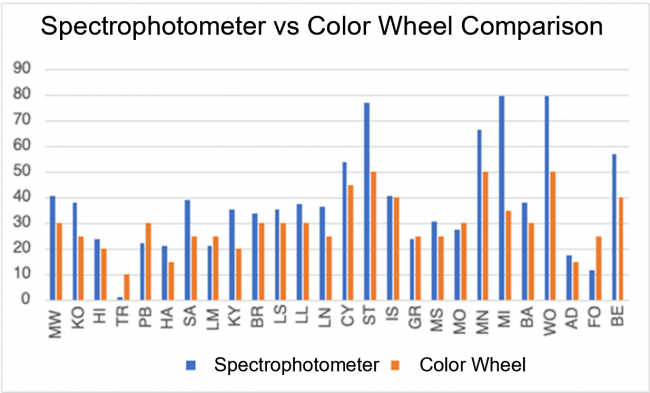
Elly gathered color data from regularly monitored lakes using a Hach color wheel and a spectrophotometer. Water color is affected by dissolved organic matter (and if unfiltered, also particles and algae). The Hach color wheel is a relatively simple and inexpensive way to measure color that LEA and many other groups across the state have been using for decades. A spectrophotometer is a more expensive lab-based analysis that measures how light is absorbed or transmitted at specific wavelengths to determine color.
Elly found that the two methods produce data that follow similar patterns, but spectrophotometer-based results provide a more precise, less objective measurement.
