


LEA school programs are always growing and changing to meet the needs of our students and the teachers we work with, and to reflect the interests of the public. Our education programs are funded through the generous contributions of our members and through grants. We are very active in the local school district and we try to offer a variety of programs to pique anyone’s interest, whether it be identifying wetland plants in a light drizzle or meeting up for a kayak, or partnering with a local land trust for a guided hike. Our programs are offered at a reduced price for members (or free!). Please consider becoming a member to support our growing programs and to help foster environmental stewardship in the Lakes Region!
We also offer many public educational programs throughout the year. Visit www.mainelakes.org/events to see upcoming events and sign up for our pop-up walk email list here.
Fifth Grade: Place Program
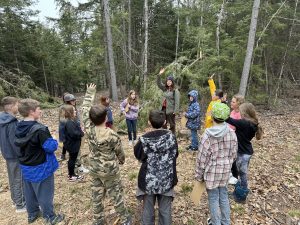
Our fifth grade program continues to evolve based on what teachers need for students to meet the Next Generation Science Standards. This school year deepening our long-time Place Program. We visit 5th grade classes at Stevens Brook, Crooked River, and Sebago elementary schools each month to explore nearby trails to learn about seasonal changes, native plants and animals, and freshwater resources. Each lesson, the students pay a visit to their special “sit spot” and write or draw about their observations. As we watch the seasons change, they learn to identify trees, animal tracks, and scat that we encounter on the trail. Their natural curiosity at this age is an asset, and through the guise of games and play-based learning we can build environmental literacy and a deeper sense of place. We end the year with a fun field trip exploring plants and animals at the Holt Pond Preserve.
Sixth Grade: Living Connections Program
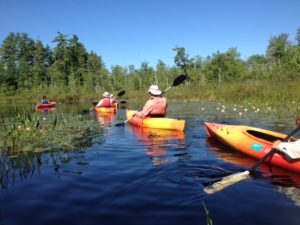
 During this year-long watershed education program, LEA visits classrooms twice per month to teach students about Earth systems, focusing on the hydrosphere. We begin the year exploring water properties. Lessons on watersheds, the water cycle, groundwater, aquatic insects, trout ecology, and wetlands help students understand interactions between the hydrosphere, biosphere, and atmosphere. For the second part of the year, we focus on threats to water quality, including invasive species and erosion. We also cover the concept that human actions can affect the quality of Earth’s systems. The culmination of this program is the Hey You! Cruise (see below). Adopt-a-Trout is an additional component of the Living Connections Program, during which students raise brook trout from eggs to fry and release them into local rivers with LEA.
Hey You! Cruise
 In June, echoes of “Hey You!” ring out over Long Lake as students participate in the annual Hey You! Cruises on the Songo River Queen in Naples. The Hey You! Cruises serve as the culminating activity for students in the Living Connections Program and as a special program for students at Waterford Elementary in Oxford and Sebago Elementary. Volunteer actors at stations along the east and west shores pretend to do things that are harmful for water quality, such as bringing in sand to a beach, cutting down the vegetative buffer, or taking a bath in the lake. Students on the Cruise have learned over the course of the year that these actions degrade water quality. So, to stop the transgressors, they yell out a resounding, “Hey You!” The Hey You! Cruises are a great way for students to make the connection between their in-class learning and real life application, allowing them to put their knowledge into action.
Seventh Grade: Field Studies at Lake Region Middle School
The Field Studies for Middle School Students Program is currently offered to all seventh grade classes at Lake Region Middle School. This program is designed to encourage students to understand ecosystem processes through direct contact with the natural world. Students engage in inquiry-based field science activities to collect and analyze forest ecosystem data. They also develop science communication skills through oral and written reports.
Lake Region High School
LEA provides courtesy boat inspector job experiences to many high school students, as well as occasional internships. These experiences enhance students’ college applications and provide real exposure to environmental career options. In the past, LEA has also offered 9th grade lessons on global water supply, shore land zoning laws, climate and erosion and has worked with the Lakes Region Envirothon team.
Homeschool
LEA loves to connect with homeschool families and regularly offers materials, ideas and curriculum, and local excursions for students learning outside of the norm. It is always a pleasure to work with homeschool groups because they have the opportunity to take time, focus in on a particular unit of study, and tweak investigations to suit their needs. Interested in learning more? Please contact emlyn@mainelakes.org.
Holt Pond
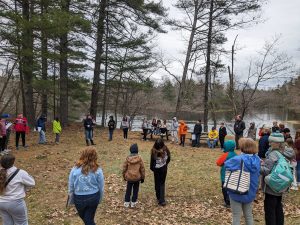
 Holt Pond is one of LEA’s outdoor classrooms. With different ecosystems within walking distance of one another, Holt Pond provides the perfect opportunity to learn about nature in its varied forms and functions. Holt Pond is a favorite field trip for local school groups. Trails are an essential part of the LEA education program, as the best way to teach about the environment is to bring people into it. It is great to visit Holt Pond in the fall, but also can happen in the spring (more black flies…)! We also have the new Highland Research Forest as an option, and can focus on forest ecosystems outside with students. Please contact alanna@mainelakes.org to set up a trip with your class!
Pondicherry Park and the Maine Lake Science Center
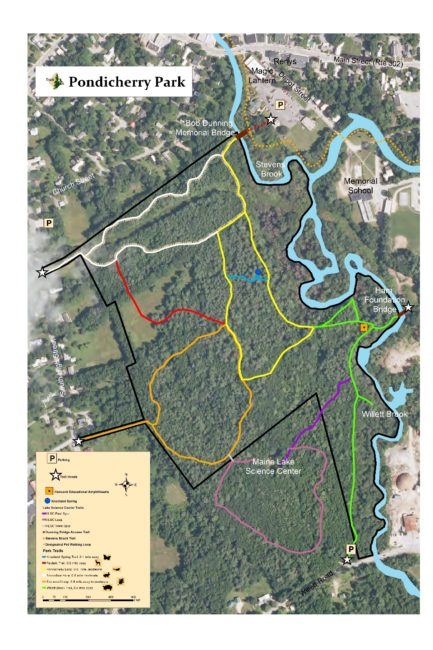
Pondicherry Park is a 66-acre tract of land in the center of Bridgton, where visitors can step away from the busy streets into the quiet of the park’s forested trails. Within the park, visitors find a wide variety of ecosystems for hands on learning and exploration. These diverse ecosystems just beyond the majestic Bob Dunning Bridge have been the location for many of LEA’s Caplan Series events including tree identification walks, animal tracking investigations, scavenger hunts for families, and native herb walks. We are also partnering with the Bridgton Historical Society to offer programs that focus on both local history and nature. Not only is the trail system in Pondicherry Park a fantastic location for adult educational walks, but it also provides an expansive outdoor classroom for student education as well. Click the map for a printable version.
Pondicherry connects us to the Pinehaven loop trail at the Maine Lake Science Center. Follow the Ray Bradburian boardwalk (think Butterfly Effect in ‘A Sound of Thunder’) to the evergreen tree trail markers from Bruce Hilton’s wood shop at the high school. This sweet addition to the Pondicherry trails weaves visitors through young tree stands, past an old car in the woods (keep your eyes peeled!), over streams, and by wetlands. Stand near the stone wall and close your eyes to imagine the whole landscape cleared of forest and instead harboring bleating sheep or crops marching along in rows. We live in an area rich with history, and our mark on the landscape is all but forgotten in the quiet whispering of the pine trees. Our most exciting addition is the low ropes course along the Pinehaven trail. This short loop around the Center has multiple low elements for climbing, balancing and swinging fun. The trail is accessible from the Pondicherry loop or from the parking area on Willett Road from dawn to dusk and is a new favorite spot for lots of families!
LEA Educators:
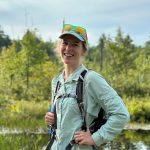 Mary Jewett is LEA’s director of Education and Invasives Prevention. She was born and raised in Bridgton and has a deep love for the great outdoors and learning about the world around her. She has many family members in the area including aunts, uncles, grandmothers, cousins and her sister. She feels very lucky to have the support of both a big family and the community. The thing she likes best about her job is seeing the hands of her students shoot up after asking “Did anyone learn anything today?”.

Emlyn Emerock is LEA’s community engagement and land use coordinator. She grew up in Vermont and has a BS in Conservation Biology and MS in Natural Resources. Emlyn previously managed a community science program at St. Lawrence University and has worked with the Loon Preservation Committee, the Appalachian Mountain Club, and Kezar Lake Watershed Association. Emlyn lives with her partner and their dog in Norway, where they enjoy skiing, paddling, and walking in the woods.
