



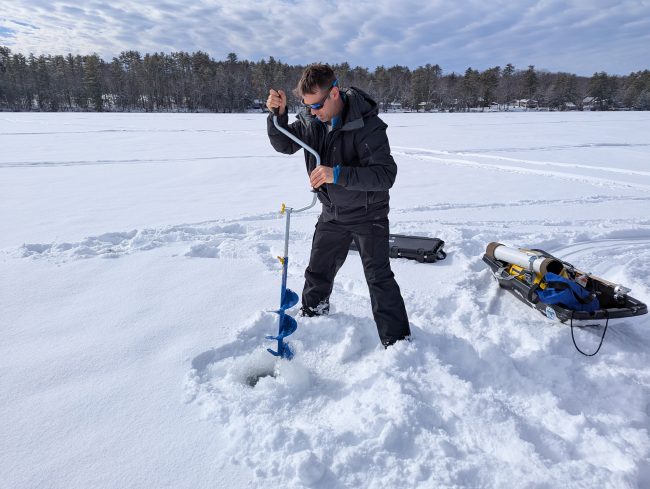
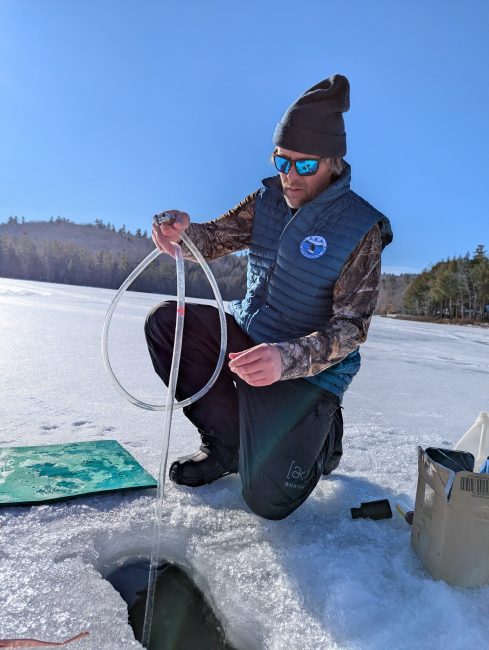
LEA collects data on ice-in, ice-out, and ice thickness on area lakes and ponds. If you’re a keen lake observer, we could use your help. Access the forms below to share your data. You can also scroll down to enter data directly on this page and learn more about our winter lake research.
LEA’s data on ice depths for local lakes and ponds is available below and is updated weekly in the winter.
Ice-In/Out Reporting
Ice-in date (also known as ice-on or freeze date) is when a lake is observed to be completely covered with ice (not counting skim ice that rapidly melts). Lakes can freeze and thaw multiple times in late fall before finally freezing over, and our big lakes often don’t freeze all at once. We are interested in both the initial ice-in date any mid-winter thawing events that result in partial ice cover.
Ice-out date (also known as ice-off or thaw/breakup date) is defined by the state as when you can navigate unimpeded from one end of the water body to the other, or by the National Snow & Ice Data Center as the date of last breakup observed before the spring open water phase. We are interested in both the last break up observed and any thawing events that result in partial ice cover.
Having both freeze and thaw dates lets us know ice cover duration, which impacts things like water levels, anoxia, and recreational use. Please help us collect this valuable data by reporting your ice-in/out observations in the form below. Thank you!
Ice Thickness Reporting
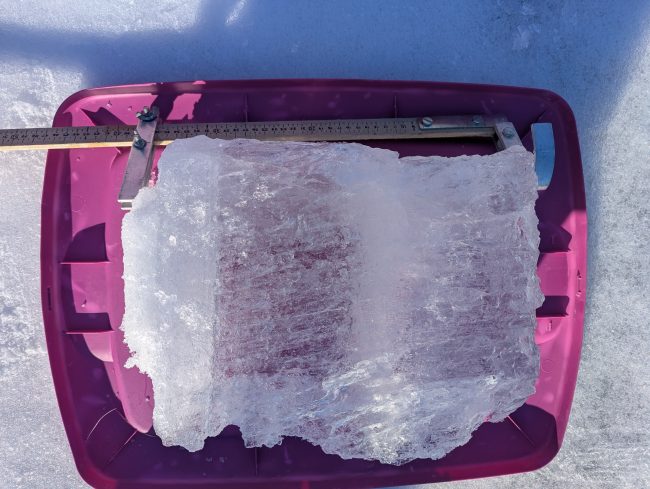
How thick is the ice? We monitor ice thickness trends over time as part of our winter water testing program. You can view recent ice thickness data from our field work here:
Do you measure ice thickness? Share measurements from on your local lake and pond using the form below.
