



LEA’s water testing program extends beyond water quality monitoring. Below are descriptions of programs LEA reports on annually. Each program is represented by a unique image. Below are descriptions of each program. Look for these icons on your lakes water quality page and yearly reports to see what programs your lake is involved in. To view this years water quality data summary, select your lake in the drop down below.
 Water Quality Monitoring: Water testing on 41 lakes and ponds in LEA’s service area occurs every year through traditional and advanced testing initiatives. Data collected and summarized in this report contribute to our long-term understanding of lake/pond behavior and health. Our data are available to the public through Maine’s Department of Environmental Protection and LEA’s annual water quality reports.
 Algae Monitoring: Algae either directly or indirectly support much of the life existing in a lake and are considered the foundation of aquatic food webs. LEA uses a fluorometer to measure chlorophyll fluorescence in the water column. Monthly fluorometer profiles are collected from participating lakes and ponds from May through September. LEA uses a flow cytometer to measure algal concentration and community composition in water samples.
 High-Resolution Temperature Monitoring: Water temperature is critical to the biological function of lakes, as well as the regulation of chemical processes. Each year, we attempt to capture the entire stratified period within the temperature record, from when stratification begins to form in the spring to when the lake mixes in the fall. With funding and support from local lake associations, LEA has deployed temperature sensors at seventeen sites on 13 lakes and ponds.
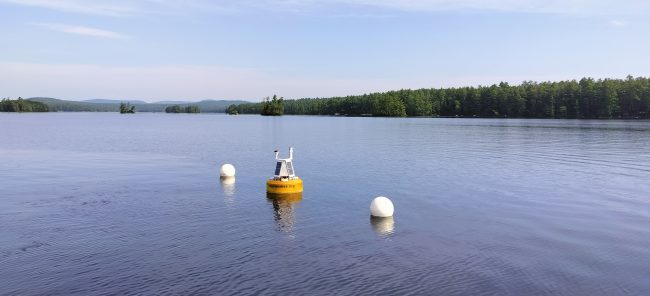
 GLEON Buoy Monitoring: Each year, LEA deploys two fully automated monitoring buoys – one on Highland Lake and one on Long Lake in the north basin. These buoys collect water quality information at 15-minute intervals throughout the spring, summer, and fall. This data is transmitted to us in real time, so we can see conditions change on the lake as they happen.
 Winter Water Quality Monitoring: Climate change plays a large role in the increased interest in winter lake conditions. Long-term records of lake freeze and break-up dates show that ice cover periods have decreased significantly for many places. LEA has joined in that effort to make wintertime field work a more regular part of lake monitoring. Data from this program are summarized in a separate report published in the spring. LEA visits 13 lakes and ponds during winter.
