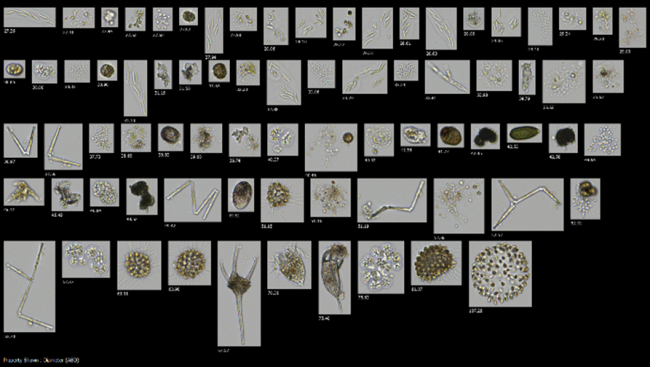
LEA uses a FlowCam Cyano flow imaging microscope (FlowCam) to quantify algal community composition of water samples collected from lakes and ponds. The FlowCam system draws water samples through an optical flow cell and uses a microscope objective and high-speed camera to detect, photograph, count, and measure fluorescing particles (mostly algae) ranging in diameter from 10 µm—100 µm. Each run stopped after 700 particles were captured or 7.5 mL of sample was processed, and a minimum of two runs were done for each lake sample to ensure the best representation of the algal
community composition. We filtered samples with 100 µm Nitex mesh, which prevented flow cell clogging and excluded particles larger than 100 µm in diameter from the analysis. Also excluded from the analysis were non-algal particles and images with more than one type of particle.
Images that can be identified are sorted into groups based on taxonomic division. When possible, we identify algal particles to the genus level, which is the taxonomic level below family and above species. Particles that can be identified to genus level are further sorted into functional groupings based on potential water quality changes associated with high densities of that genus. Images showing particles that are clearly not algae are not included in community composition analysis. In this report, we have listed the 3 dominant types of algae identified and categorized by genus. We have also noted whether there were any problematic or nuisance algae and whether the amount was at a level of concern for water quality.
Flow Microscopy Collection Methods
LEA staff collected integrated surface water samples from the deep location on each lake. Sampling was done once monthly during our regular August and September lake monitoring visits. The sample water was returned to the Science Center the same day it was collected, stored overnight in a refrigerator, and analyzed with the FlowCam the following day. Below are examples of images of algae produced by the FlowCam.