Live Stakes: Lake Friendly and Affordable Buffer Vegetation
Could your shoreline benefit from more vegetation? Early spring provides a short window of opportunity to quickly and inexpensively add plants with minimal effort.
Live stakes are cuttings from woody shrubs that root when planted. Installing live stakes can be a free or very affordable way to increase vegetation along your shoreline. Most species that are suitable for live staking are shrubs – they don’t grow very tall and provide excellent shoreline stabilization. Live stakes are typically 2-3 feet long and are planted directly into the ground in the spring while they are still dormant. New cuttings typically take 1-2 years to establish new roots, so be patient the first year!
Species well-suited for live staking are listed below, and both native and cultivated varieties will work. You can collect cuttings yourself if you know a landowner with established plants who will allow you to harvest, or you can purchase your stakes from a local nursery.
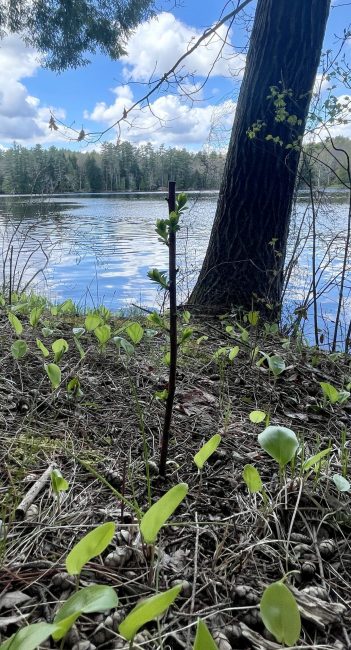
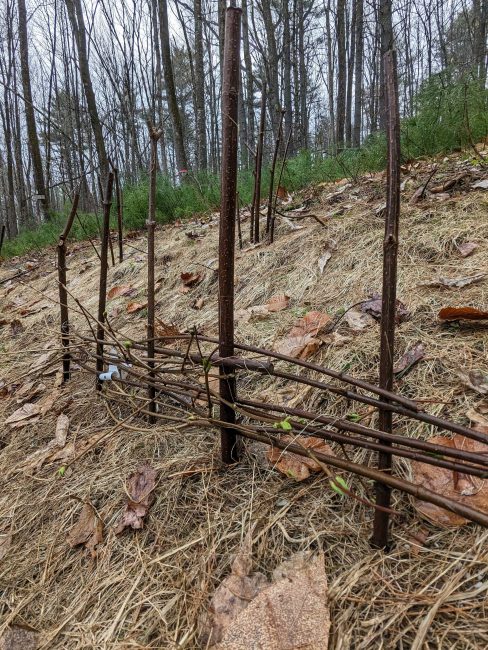
Meadowsweet live stake (30 Mile River Watershed Association).A “living wattle” – willow live stakes woven together to create a small fence (LEA).
Recommended Plants for Live Staking:
Red-osier/red twig dogwood (Cornus sericea)
Gray dogwood (Cornus racemosa)
American elderberry (Sambucus canadensis)
Arrowwood (Viburnum dentatum)
Nannyberry (Viburnum lentago)
Ninebark (Physocarpus opulifolius)
Pussy willow (Salix discolor)
Missouri river willow (Salix eriocephala)
Buttonbush (Cephalanthus occidentalis)
White meadowsweet (Spiraea alba)
Balsam poplar (Populus balsamifera)
Source: Maine DEP
Planting Instructions:
Live staking is best done in late March or April while plants are still dormant.
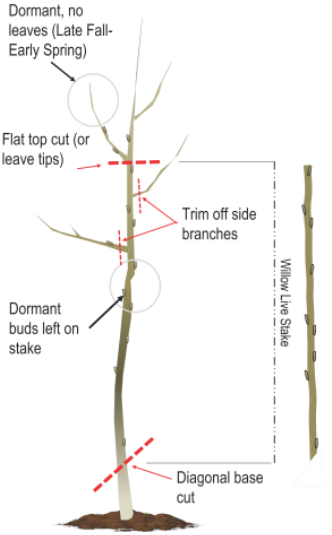
Cuttings should be 2-3’ long enough with several nodes present – these will form roots, new roots, and branches. Remove all side branches.
The diameter of cuttings should be about the same as your thumb. Larger stakes have more stored energy and often sprout more vigorously.
Plant stakes promptly after cutting (or purchasing). If storing, keep outside in a bucket of water until the day of planting. Stakes will dry out if they aren’t kept moist and cool.
Keep the cutting upright when planting— the thicker end is usually the bottom, with the buds pointing up. Take care not to damage the buds, strip the bark, or split the stake.
Cut the bottom end of the stake to a sharp point to help push it into the ground, or pre-drill a hole by hammering a wooden stake or piece of rebar into the ground. A spade can be used to create a slim crevice to plant in.
Set the stake as deep as possible into the soil. A 3’ cutting should go 2’ into the ground. A good rule of thumb is to get 2/3 of the cutting underground to promote rooting and reduce the risk of it drying out. Success is maximized if the stake is planted in moist soil.
Live stakes can be spaced 1-3 feet apart or in dense groupings. If planted correctly, you can expect 50-80% success.
Edgewood Nursery in Falmouth offers cuttings of several willow varieties, and Fedco Trees Co. has cuttings available for pre-order in the winter. Let us know if your local nursery also carries live stakes.
Download this Live Staking article as a shareable PDF here.
Article contributed by Roy Lambert and Emlyn Emerock
If you have questions or would like to schedule a free LakeSmart evaluation on your property, contact LEA Land Use Coordinator Emlyn Emerock at emlyn@mainelakes.org or 207-647-8580. For more information about the LakeSmart program and lake-friendly landowner resources, visit mainelakes.org/resources/lakesmart.